Friday, 28 June 2013

Swiss Sojourn

I've just returned from an enjoyable break staying at the home of some friends on the shores of Lake Geneva. As it was a holiday there was little scope for spending time with the brushes, indeed the only kit I had with me was a small box of watercolours and a block of Not paper. 

Daytime excursions gave me the opportunity to make lots of photographs as well as a few sketches for future reference so my main painting activity took place in the evenings. The selection of pictures here reflect this activity.

The first picture is the view from the terrace of the house where we were staying and it was a delight every day to witness the changing conditions and light. This view in all its forms provides the vast majority of my photographs. Future painting projects will reflect the many changes seen from this spot.


Lake Geneva - Watercolour on Not paper 12" x 9"

I was delighted when the family who own the house decided that they would like this picture for their walls.

To keep the brushes operating on a regular basis I got into the habit of setting up a few artefacts to provide still life compositions for the evening and the following pictures represent some of those sessions.


Still Life 1 - Watercolour 12" x 9"


Still Life 2 - Watercolour 12" x 9"


Still Life 3 - Watercolour 12" x 9"


Still Life - Watercolour 12" x 9"

Monday, 10 June 2013

Charles Reid at Burford - Third Demonstration, Still Life

Our third demonstration was the perennially popular still life session where Charles puts together a selection of artefacts, fruit and flowers to make an arresting image.


The Set Up

Charles regularly states that he likes a haphazard arrangement reflecting the way objects are left rather than the more formal arrangements liked by some still life painters. For him the arrangement should have lots of connections between the various artefacts.

As usual the drawing is done in the contour style, pencil remaining on the paper. The first thing drawn was the vase and all the other elements were drawn in relation to it. There was very little detail in the blooms.


The Drawing

The first strokes of paint were foliage, placed in such a way that they created a series of negative shapes, particularly around the white blooms. The foliage colour was largely mixed on the paper and the different pigments can be seen in the photograph.


The First Strokes

The next photograph shows a detail where you can see the range of pigment used in rendering foliage and blooms.


Detail

In moving around the painting Charles makes sure that he paints connections and often has pigments running into each other as he does so.


Moving Around

As he moves around and begins new passages he ensures that he keeps his brush on the paper till requiring more pigment. The same routine with the brush is followed each time. The brush is loaded with water, excess is shaken off then the brush is put into the pigment which is kept at a moist consistency before being applied to the paper. He then ensures that the contact with the paper is made with the whole of the brush and not just the point. Brush longevity is a consideration when using expensive sable implements.

The background of the painting is hinted at with a few splashes, warm and cool, to provide a little texture. Splashes are a regular technique used by Charles who is likely to add a few whenever he thinks that he is tightening up.

Another great demonstration.


Still Life - Charles Reid, watercolour on half sheet

Tuesday, 4 June 2013

Charles Reid at Burford - Second demonstration - Portraits

The second demonstration that Charles set up was a portrait session and unusually he declared that he was going to produce two portraits, one profile and another in three quarter view. As always the session started with Charles producing a contour drawing. During this segment we were to listen to many sound tips in relation to making the original drawing. 

"Begin by putting down a light oval shape to delineate the placement of the head.

Draw a line around the curve of the oval to mark the line around which the central features are arranged.

Start the detailed drawing at the eyes or nose and relate everything back to them.

Place mouth with dot relating to the eye.

Many people make noses too long, beware of this.

Keep stopping and checking whilst keeping the pencil on the paper. 

Draw in shadow shapes".


Initial Drawing - note shadow shape beside left eye and small demo of an eye at top

"Begin painting  around centre and put in dark shapes.

Draw in shapes with the point of the brush then soften them".


Charles spent some time showing the choices he makes to produce his flesh tones and shadow shades, these can be seen at the bottom of the sheet. The colours will vary according to the individual's complexion. Simply they consist of Cadmium Red Light with a yellow from Cadmium Yellow Light, Raw Sienna and sometimes Burnt Sienna. The addition of a blue creates the shadow and the choice is judged by the value required, Cerulean, Cobalt and Ultramarine being his choices, light to dark.


Profile - Charles Reid, watercolour on half sheet

Charles then moved onto the second view of the model with the same routine in terms of drawing.
In this picture it is easier to see some of his construction lines in this picture. Note the line delineating the central features and the arc across the eyes. You can also see the oval placed to indicate the nose position. Most of these lines are reduced by eraser so that they are lighter than pictured here but many are not removed altogether.


Three Quarters view - Drawing


Initial washes


Sheet layout


Three Quarter view completed

In the above photograph you can see the notes that Charles appended. Here he emphasised the technique he uses next to highlights. The hard edge next to the highlight is placed and keeping the brush on the paper the pigment is worked away then softened.


Two Portraits - Watercolour on half sheet by Charles Reid

Thursday, 30 May 2013

Charles Reid at Burford - First Demonstration

As mentioned in my last post, events conspired to curtail my opportunity to work with Charles Reid on his latest visit to England. However I did get the chance to spend a couple of days with the master during his second week here in Burford. The activity on his first week at Stow in the Wold has been well reported by my friend Peter Ward on his blog to be found at www.watercolourfanatic.blogspot.com. 

Instead of the usual day by day report, this will be slightly different in that Charles broke from his normal pattern of making one demonstration per day by completing two on one of the days that I was able to attend. So from two days I managed to see three demonstrations, a bonus for me.

As is his practice on these occasions Charles likes to do some work from old monochrome source material and usually provides a choice of images culled from vintage photographs. This time some of the images were drawn from the famous Sutcliffe collection, depicting people in the environs of Whitby plus one or two images like the Sargent portrait that I selected for my effort that day. Charles used two images from Whitby as his inspiration. The importance of using monochrome images is in the demands it makes of the watercolourist in terms of drawing but more importantly the rendition of values without the visual crutch of original colour. The focus of the artist then becomes establishing accurate values and leaving colour choices to the taste of the individual. It makes for interesting choices for the artist. 

Charles is a keen advocate of the contour drawing method and he makes great emphasis of the need to keep the pencil on the paper whilst making the drawing, even when moving across the image from one segment to another. The emphasis is all to do with establishing accurate relationships between the various elements of the picture. 


Initial Drawing

Planning the picture requires giving some thought to the proportion of figures within the space available on the paper.

After completing the drawing the time comes to begin the application of paint. Charles invariably begins work on the central features of the face. This could be the eye socket, nose or the central portion of the mouth. Each stroke is applied and worked towards another area, his maxim being, 'Place a stroke then soften an edge'.


The Face Emerges

Moving away from the centre line the importance of making good shapes is emphasised, 'Good shapes make good paintings'.

Another important point is the in relation to the accurate value relationships. Unlike many watercolourists Charles likes to begin with the placement of some dark values, thereby having something to relate to when making middle and light values. It is important to to have a clear idea of where these relative values lie.


Developing the Figure

After developing the figure Charles begins work on the boat, an important compositional element.


Overall Composition


Boat Detail

Once the work on the boat is complete The whole piece is tied together by the addition of the background and sky, lightly applied and impressionistic.


Final Image - Watercolour on half sheet by Charles Reid

The major teaching points made by Charles in this session were as follows:

Good shapes make good paintings;

You should always be able to see the point of your brush, this gives you more control over your shapes;

Keep pencil on the paper when drawing;

Keep the brush on the paper when making shapes;

Place a shape, press and lift off then soften an edge;

Always try to have about half of your shapes have soft edges;

Look for relationships between shapes and make connections;

Look for intersections and use them as connections;

Start with darks first;

Check out values, where are the mid values?

Paint shapes with harder edge next to the light then work into the shadow;

Make sure you have colour changes in the darks;

Always try to make a balance between warm and cool colours in your shapes.

Another inspirational session and the reinforcement of many of the ideas that Charles has been espousing for many years. 


Thursday, 16 May 2013

Back in the Saddle

After a few little local difficulties, medical and bereavement I've managed to get a little painting this week. I was originally scheduled to be on a course with the wonderful American painter, Charles Reid, but events conspired to stop me going on my original booking. Other complications made it just possible for me to attend two days with Charles during this week and I will post something about it when I can get round to it. In the meantime my fellow blogger, Peter Ward (watercolourfanatic.blogspot.com), is recording his experience with Charles during last week. Recommended reading.

One of the exercises that Charles likes to have students work at is one where you take a monochrome photograph and make a painting based on the image. This is my effort during one of those sessions. The photograph I selected is a well known shot of John Singer Sargent at work.

It was wonderful to get the brushes damp again after an enforced break. Not quite finished off but satisfying nevertheless.


John Singer Sargent - Watercolour on Not paper 16" x 12"

Tuesday, 16 April 2013

Close to Home

After suffering the poor light and howling gale on Sunday, I arose this morning to look out of the window and see the sun. With nothing else to do today I decided that painting was the thing to do. The problem of today became apparent when I opened the door. Light there might be but the wind was even stronger than on Sunday.

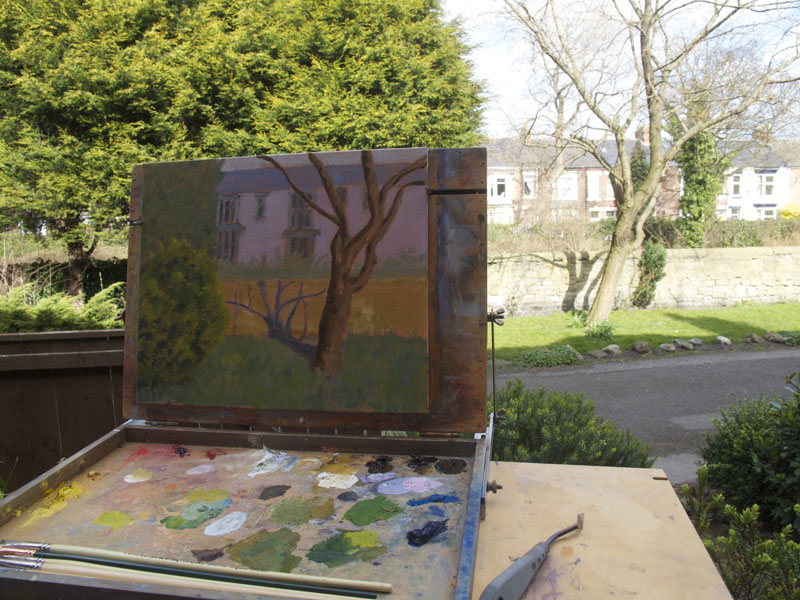
The thought struck me that I had heard someone say that seeking subjects was not necessary and that painting whatever was in front of you could produce pleasant surprises. It just so happened that the front of our house provided some shelter from the wind and the light was producing shadows, so I set up just outside my front door and got down to it.

As reported last time I was making my first plein air expedition so I am still trying to get into shape. It's amazing how a bit of light makes you feel and today's effort was a positive step in the direction of making a decent plein air piece. Not there yet but heading in the right direction.   


Set Up - photograph


Hunter Terrace - Oil on canvas board 12" x 10"

Sunday, 14 April 2013

First Plein Air of the Year

The weather in this part of the world has been so bad for so long that heading out to paint plein air has not held its usual attraction. Today I met a couple of painter friends and headed out to a local landmark, Penshaw Monument. For those of you with a little knowledge of North East folk lore, it is the place that the Lambton Worm wrapped its tail around, immortalised in the eponymous song. 

Speaking of the weather, the day was grey with flat light and a howling gale to cope with so the initial outing wasn't the comfortable day it might have been. Enough of the excuses, it was fun to be out again and though the result is disappointing I'm looking forward to the next day out.


Penshaw Monument - Oil on canvas board 12" x 10"